Decentralized Kingdom · Bryan Bartels
What if Christianity describes the architecture of human flourishing?
Christianity has often been dismissed as mythology, inherited tradition, or arbitrary moral rules. But what if the Kingdom Christ described reveals principles that can be examined through their consequences—in the individual, the family, and civilization itself?
What if the way we live determines the kind of world we collectively build?
Ancient truth. Observable consequences.
An emerging understanding of the Kingdom of God.
Foundational Visual Theology
THE KINGDOM IS BUILT FROM WITHIN
One King. A Kingdom Expressed Through Many.
The traditional pyramid concentrates power at its peak, ruling top-down. The Decentralized Kingdom turns that image upside down. Christ is the source; His Spirit is given to His people, and their collective character shapes the institutions of the visible world.
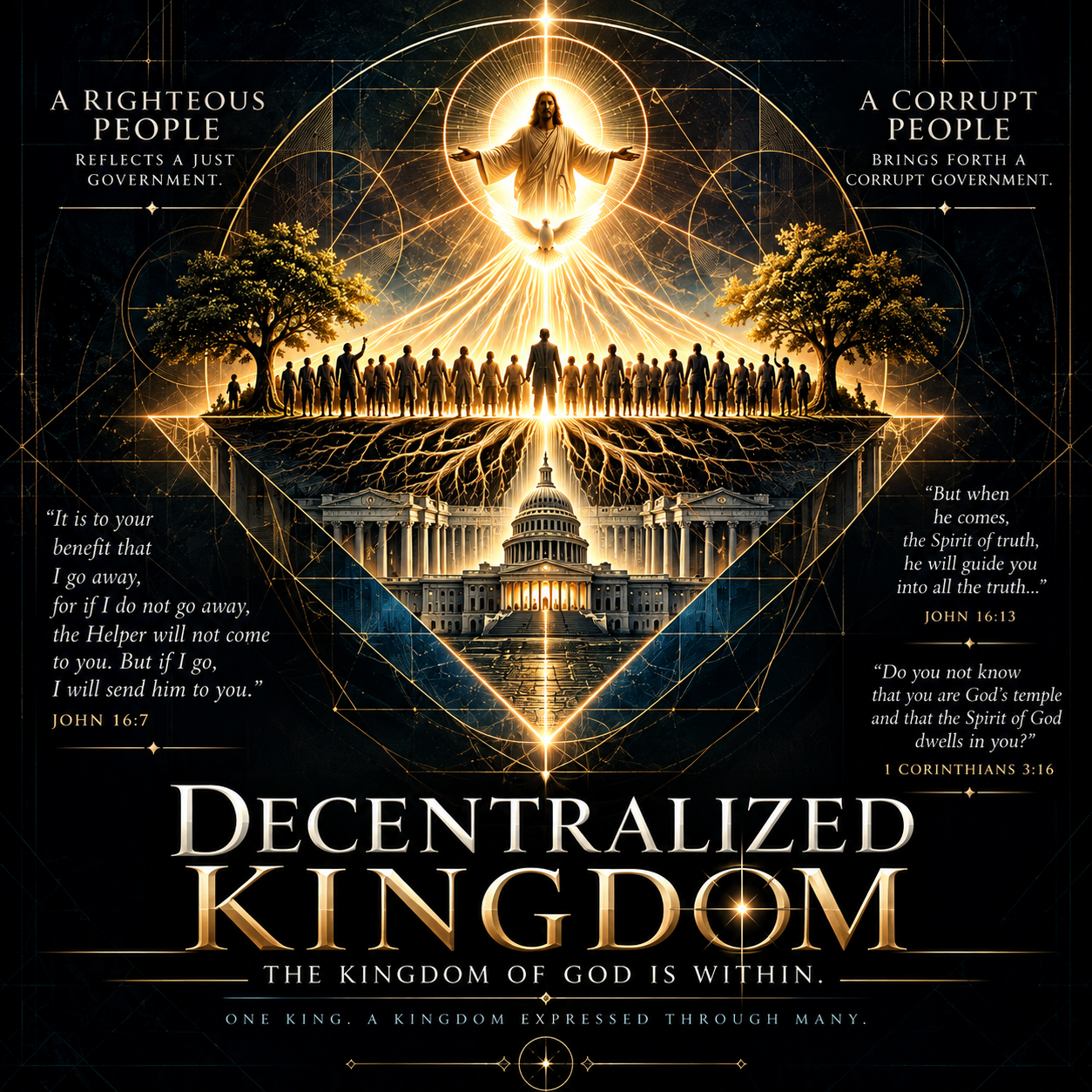
The Inverted Pyramid
The traditional pyramid concentrates power at its peak.
The Decentralized Kingdom turns that image upside down.
Christ is the source. His Spirit is given to His people. As individuals reflect His character through their daily actions, their collective lives shape families, communities, institutions, and government.
The Kingdom’s authority remains with Christ, but its expression is distributed through those who follow Him.
Government appears at the narrow bottom of the inverted pyramid—not as the source of righteousness, but as one institution influenced by the character of the society it serves.
Scriptural Foundation
John 16:7
“It is to your benefit that I go away, for if I do not go away, the Helper will not come to you. But if I go, I will send him to you.”
Christ tells His disciples that His departure is to their advantage because He will send the Helper, initiating the universal indwelling of His Spirit.Translation: ESV
1 Corinthians 3:16
“Do you not know that you are God’s temple and that the Spirit of God dwells in you?”
Paul describes God’s people as His temple, in whom His Spirit dwells. The center of divine presence is no longer an external building, but living human persons.Translation: ESV
Luke 17:21
“Neither shall they say, Lo here! or, lo there! for, behold, the kingdom of God is within you [or in your midst].”
Jesus declares that the Kingdom of God is present among His hearers. (Note: translations differ between “within you” and “in your midst,” reflecting both the interior renewal of the heart and the relational presence among a gathered people.)Translation: ESV / KJV note
The Civilizational Principle
A RIGHTEOUS PEOPLE REFLECTS A JUST GOVERNMENT.
A CORRUPT PEOPLE BRINGS FORTH A CORRUPT GOVERNMENT.
A philosophical & interpretive thesis of Decentralized Kingdom
Interpretive note: Institutions are also shaped by laws, economic incentives, historical inheritance, and power structures; this principle emphasizes the profound causal relationship between collective character and governance, rather than claiming that every government at every historical moment perfectly represents its people.
A Different Way of Seeing
What if the commandments are descriptions of reality?
We often understand moral teachings as rules imposed from outside us. But consider another possibility. What if truthfulness, faithfulness, self-control, justice, mercy, and love are not arbitrary demands, but principles with consequences for human relationships and the societies we build?
When trust becomes widespread
Promises carry weight. Families can plan. Cooperation scales. Commerce can function. Restraint protects the vulnerable. The conditions that support human flourishing become possible.
When exploitation becomes normalized
Trust deteriorates. Promises erode. Institutions corrupt. Restraint gives way to appetite. A society begins consuming the inheritance it was meant to preserve—and the cost is simply delayed.
These are not religious assertions. They are questions about how human beings and civilizations actually work—and what Christ may have been revealing about them.
The Kingdom & Human Flourishing
The invisible principles behind visible outcomes
Flourishing is not the same as wealth. It is the abundance of life that becomes possible when truth, trust, responsibility, justice, and generational stewardship work together. These are the four connected domains where the Kingdom becomes observable.
The Individual
Identity, self-control, integrity, purpose, responsibility, and character.
Flourishing begins with a person whose interior is governed by truth rather than appetite. Christ taught that the Kingdom arrives first as a seed in the heart.
Explore Domain 02The Family
Faithfulness, trust, sacrifice, care, reconciliation, and generational continuity.
The family is where the Kingdom is first tested or first lost. Faithfulness and sacrifice here become the soil of the next generation—or its famine.
Explore Domain 03The Community
Cooperation, reciprocity, mercy, justice, and mutual responsibility.
Where individuals have learned self-government, communities of trust become possible. Mercy and justice are not abstractions; they are the fruit of ordered persons.
Explore Domain 04Civilization
Human dignity, accountable institutions, protection against exploitation, social trust, and the conditions that support flourishing.
Civilization is the accumulated exterior of millions of ordered—or disordered—interiors. This is the domain where the Kingdom's fruit becomes visible at scale.
ExploreA note on human dignity and rights
Christianity grounds human dignity in the image of God—something given, not achieved—and this conviction has shaped modern rights traditions. But prosperous societies and human rights did not arise from Christianity alone. The honest inquiry examines other historical influences, competing interpretations, and the evidence for how moral and spiritual principles interact with institutions, economic conditions, and human behavior.
The Decentralized Kingdom
One King → A Kingdom Expressed Through Many
The Kingdom's authority is centralized in Christ; its expression is distributed through the people who embody His character. This is the signature framework of the project.
One King
The Kingdom has one King: Jesus Christ. Its authority is not decentralized—its expression is distributed through people who embody His character.
Many People
Every human being offers their abilities, attention, labor, and actions in service of something. Romans 6 names this as offering ourselves as instruments of righteousness or unrighteousness.
Daily Actions
Those individual choices do not remain isolated. They shape character. Character shapes relationships. Relationships shape institutions.
Collective Consequences
Institutions influence the societies we collectively inhabit—and the inheritance received by the next generation. The Kingdom's expression occurs through participation.
The governing sequence
What we attend to
Who we become like
What we embody
What we make visible
What we behold shapes who we become. Who we become shapes what we build.
“Present yourselves to God… and your members to God as instruments for righteousness.”
Featured Investigation
The Kingdom Hypothesis
What if Christ was describing the conditions under which humanity flourishes? A series of investigations examining whether the Kingdom of God describes an intelligible order with observable consequences.
The Choice
Which Kingdom are we making visible?
The conflict between kingdoms does not remain in heaven, theology, or abstraction. It passes through human consciousness, takes form through human action, and becomes visible as culture, civilization, and inheritance. We are not merely living inside a world. Together, we are building one.
What we serve within becomes the world we build together.
Ancient Truth · Future Sound
Ascendant Fusion
Decentralized Kingdom explores the principles through writing, research, and visual teaching. Ascendant Fusion expresses those same principles through sound—cinematic electronic music, spoken word, atmospheric bass, and experimental dubstep.
The first planned connection: The Mirror — Behold. Reflect. Become.

Writings
Essays & Explorations
The Kingdom of God
What Jesus actually meant by a kingdom that is both here and still coming.
Read More AI & TechnologyThe Gospel in the Age of AI
When intelligence is no longer uniquely human, the ancient questions return.
Read More SymbolSymbolic Collapse
How a civilization keeps its symbols but loses what they point toward.
Read More CultureThe Prodigal Civilization
A culture that has taken its inheritance and spent it in a far country.
Read More The FrameworkThe Two Kingdoms
Two directions, two futures—one built on borrowing, one on sacrifice.
Read More PsychologyThe Science of Sin
Sin as a mechanism that borrows from the future to fund the present.
Read More The FrameworkDegeneration vs. Regeneration
Two arcs that move in opposite directions through the same human material.
Read More PracticeBuilding Your Kingdom Backwards
Begin with the person you wish to become. Sacrifice backward toward them.
Read More ScriptureThe Living Word
Scripture as something that acts—not merely something that informs.
Read More DeconstructionFrom Deconstruction to Reintegration
The goal is not the faith you had, but what survives the questions.
Read MoreLibrary
Go Deeper
The Kingdom Map
AvailableA visual guide to the Kingdom of God.
ExploreThe Gospel in the Age of AI
Coming SoonA book exploring Christianity, humanity, meaning, and artificial intelligence.
PreviewFrom Deconstruction to Reintegration
Coming SoonA guided journey for people rebuilding faith after questioning inherited Christianity.
PreviewThe Science of the Kingdom
Coming SoonA visual exploration of truth, sacrifice, order, regeneration, and civilization.
PreviewAsk the Kingdom AI
Ask the Kingdom AI
Explore these ideas through conversation. A future AI assistant trained on Bryan Bartels' writings—available to question, challenge, and follow wherever your curiosity leads.
Try asking
- “What do you mean by symbolic collapse?”
- “How does sin produce degeneration?”
- “What is the difference between deconstruction and reintegration?”
- “What does AI reveal about human identity?”
- “Where should I begin if I'm questioning Christianity?”
Kingdom AI
Coming soon · Thinking with you
About
The Questions Didn't Destroy My Faith. They Changed What I Could See.
I'm Bryan Bartels. For more than thirty years I've been thinking about Christianity, theology, technology, psychology, culture, and meaning. My own journey moved through deconstruction, disintegration, discovery, and reintegration. This project is not about pretending difficult questions don't exist. It is about following those questions deeply enough to discover whether something more profound exists beneath the religious language people often reject.
Go Deeper Than the Feed
Go Deeper Than the Feed.
Receive new essays, diagrams, Kingdom Maps, and explorations of Christianity, culture, psychology, and artificial intelligence.
Free with your subscription: The Kingdom Map — A Visual Guide to Degeneration and Regeneration